FREE Sketch Bus Icon: Versatile, Scalable Assets for Public Transport Design
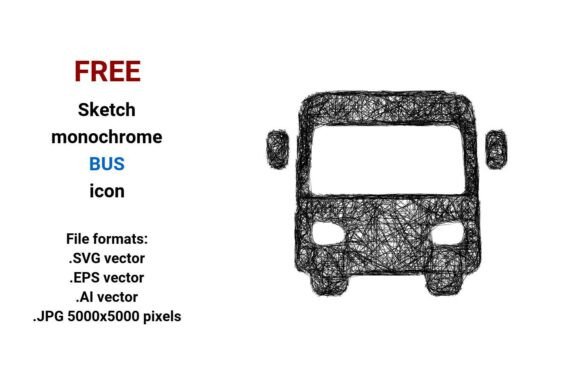
Whether you're building a transit app, designing a city mobility website, or crafting an educational poster about sustainable commute options, the right visual element can anchor your message instantly. A FREE Sketch Bus Icon isn’t just decorative—it’s functional, expressive, and deeply tied to how users perceive public transport at a glance. What makes this particular set stand out? Four fully editable file formats—.SVG vector, .EPS vector, .AI vector, and high-res .JPG (5000×5000 pixels)—all delivered in clean black-and-white sketch style.
Why Sketch Style Works So Well for Public Transport Interfaces
A handdrawn, sketchy aesthetic brings warmth and approachability to otherwise technical subjects like route planning or transit scheduling. Unlike sterile flat icons, a sketch bus icon subtly signals accessibility, human-centered design, and community focus. Think of it as visual shorthand for “this tool is made for people—not just data.” That’s why designers increasingly reach for rough sketch icons when building apps for school districts, local governments, or nonprofit mobility initiatives.
It’s not about looking unfinished—it’s about intentionality. The visible pencil stroke, slight line variation, and organic weight in a handdrawn bus icon reinforce authenticity. Users subconsciously associate that texture with care, transparency, and real-world relevance—qualities that matter deeply in public transport communication.
Vector Files: Your Design Flexibility, Locked In
A vector image is built from mathematical points, lines, and curves—not pixels. That means whether you’re placing the icon on a tiny mobile UI button or blowing it up across a 12-foot transit shelter banner, clarity stays perfect. No blurriness. No pixelation. Just crisp, consistent detail at any scale.
- .SVG vector: Ideal for websites and web apps—lightweight, responsive, and natively supported by all modern browsers. Easily styled with CSS (change stroke color, animate on hover, adjust opacity).
- .EPS vector: Industry-standard for print workflows. Use it confidently in brochures, posters, or signage where CMYK fidelity matters.
- .AI vector: Fully editable inside Adobe Illustrator—adjust individual anchor points, tweak stroke width, recolor paths, or integrate into larger illustration systems.
- .JPG (5000×5000): High-resolution raster fallback for platforms that don’t support vectors—email templates, PowerPoint decks, social media banners, or legacy CMS environments.
This multi-format flexibility means one FREE Sketch Bus Icon purchase—or download—covers nearly every production need. You’re not buying an icon. You’re acquiring a production-ready bus vector asset that adapts seamlessly across digital and physical touchpoints.
Real-World Uses Across Industries
Designers aren’t hoarding these icons for mood boards alone. They’re actively deployed:
- Transit Apps: As a bus button in navigation flows—tapping it reveals real-time arrival data or route maps. The sketch style softens the interface, reducing perceived complexity.
- Educational Platforms: Used in interactive lessons about urban planning or environmental science. A doodle icon feels less intimidating to students than a rigid corporate symbol.
- City Websites & Portals: Embedded in “Plan Your Commute” modules, where the sketch bus icon acts as both visual anchor and intuitive call-to-action.
- Print Campaigns: Applied to bus stop decals, bike-share kiosks, or “Try Transit Tuesday” flyers—where the pencil-inspired texture adds tactile appeal even in static form.
Notice how often the word commute appears—not as jargon, but as lived experience. That’s intentional. Good public transport design doesn’t shout infrastructure; it acknowledges rhythm, routine, and human movement. A sketched icon supports that narrative without competing with it.
Editing & Customization: Built for Iteration
Unlike locked PNGs or icon fonts, this FREE Sketch Bus Icon set invites modification. Open the .AI or .EPS file, and you’ll find layered paths, grouped elements, and consistent stroke profiles—no flattened artwork, no hidden raster layers. Want to:
- Add a subtle shadow for depth in a dark-mode UI?
- Swap black strokes for brand-color blue to match your municipal palette?
- Isolate just the bus silhouette and pair it with a custom route line or stop marker?
- Convert the sketch into a duotone version for a modern editorial layout?
All of it is possible—without starting from scratch. That saves hours across sprints, especially when stakeholders request rapid iterations or A/B test variations. It also future-proofs your work: as your project evolves, so can the icon.
UI/UX Considerations: When Sketch Meets Function
Using a sketchy icon in interface design demands attention to contrast, spacing, and context. Here’s what seasoned designers watch for:
- Legibility at small sizes: The black-and-white simplicity ensures recognition even at 24×24px—critical for mobile app toolbars or tab bars.
- Consistency within icon sets: If your app uses other sketch-style icons (e.g., train, bike, pedestrian), this bus icon harmonizes effortlessly—same stroke weight, same roughness level, same visual language.
- Accessibility: High-contrast black-on-white meets WCAG AA standards for non-text elements. Pair it with clear label text (“Bus Routes”) for screen readers.
- Emotional resonance: In stress-heavy contexts—like missed connections or service alerts—a softer, handdrawn treatment reduces friction and builds trust.
It’s not just about looking good. It’s about supporting cognitive ease during real-life moments: rushing to catch the 7:42 a.m. bus, navigating an unfamiliar transfer point, or helping a visitor understand their route options in under five seconds.
Why “Free” Doesn’t Mean “Limited”
“FREE Sketch Bus Icon” might raise eyebrows—especially when bundled with professional-grade vector formats. But here’s the reality: many creators release high-fidelity assets freely to fuel open design ecosystems, encourage reuse in civic tech, or simply grow their portfolio through attribution. This set reflects that ethos: no watermarks, no usage caps, no forced sign-ups.
That freedom extends to licensing too. Unless otherwise specified, most free sketch icons allow commercial use—ideal for startups building SaaS tools for transit agencies or freelance designers crafting pro-bono awareness campaigns. Always verify the license, but know this: a truly usable FREE Sketch Bus Icon is rare, valuable, and worth bookmarking.
Final Thought: Icons Are Infrastructure Too
We invest in rails, buses, bike lanes, and signal timing—but we rarely talk about the icons guiding us along the way. Yet they’re part of the same system: invisible infrastructure that shapes understanding, reduces uncertainty, and quietly enables better decisions. A well-chosen sketch bus icon does more than represent a vehicle. It represents possibility—the chance to move freely, safely, and collectively through shared space.
So whether you’re mapping a new public transport corridor, prototyping a commute planner, or refreshing a decades-old agency website, treat your icon choice with the same rigor you’d apply to routing algorithms or fleet maintenance schedules. Because in the end, clarity, empathy, and scalability aren’t just design goals—they’re public service values.