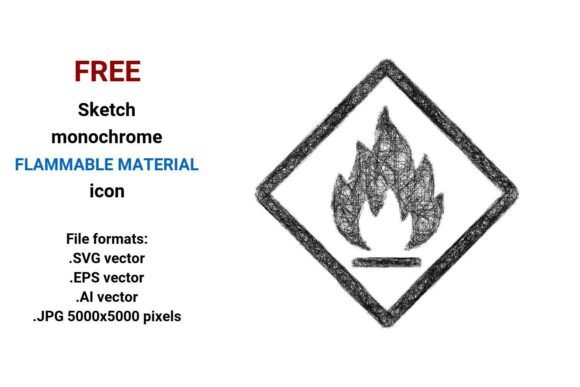
FREE Sketch Flammable Material Icon: Practical, Scalable, and Design-Ready
Designers, safety officers, educators, and product developers increasingly need visual assets that communicate risk clearly—without sacrificing aesthetic flexibility or technical precision. The FREE Sketch Flammable Material Icon meets that need head-on: a hand-drawn, monochrome pictogram representing flammable, combustible, and fire risk material in a style that feels human, intentional, and trustworthy. Unlike generic clipart or overly clinical ISO symbols, this icon balances regulatory clarity with creative warmth—making it equally effective on a lab safety poster, an industrial UI kit, or a digital training module.
Why Sketch Style Matters for Safety Communication
Safety icons have long leaned into rigid geometry—sharp angles, bold outlines, uniform strokes—to signal urgency and authority. That works well for standardized signage, but modern interfaces demand more nuance. Users today interact with safety information across apps, dashboards, internal wikis, and responsive documentation—not just printed labels. A sketch-style icon introduces subtle visual cues: the slight irregularity of a pencil line suggests human oversight; the organic curves imply careful interpretation rather than blind compliance. It signals, “This isn’t just a warning—it’s a shared responsibility.”
This shift reflects broader design trends: the rise of human-centered UI kits, the preference for authentic texture over sterile perfection, and growing awareness that clarity doesn’t require coldness. In fact, studies in technical communication show that users retain safety instructions longer when paired with relatable, non-robotic visuals—especially in mixed-audience environments like vocational classrooms or cross-functional engineering teams.
Four Formats, One Consistent Visual Language
The FREE Sketch Flammable Material Icon ships in four production-ready formats: .SVG vector, .EPS vector, .AI vector, and a high-resolution .JPG (5000×5000 pixels). Each serves a distinct role in real-world workflows:
- .SVG: Ideal for web use—embed directly into HTML, scale responsively, apply CSS filters or hover effects, and maintain crisp rendering on any screen.
- .EPS and .AI: Native vector formats for professional print, CAD overlays, or integration into larger technical illustrations. They preserve editable layers, anchor points, and Bezier curves—critical when adapting the icon for custom schematics or compliance diagrams.
- .JPG (5000×5000): A fallback for platforms that don’t support vector imports—think presentation decks, PDF reports, or legacy CMS systems. Its resolution ensures sharp detail even when zoomed or printed at poster size.
This multi-format approach respects how people actually work. A freelance instructional designer might drop the SVG into a Figma prototype, while a manufacturing QA lead inserts the EPS into a plant-floor SOP manual. Neither has to convert, trace, or compromise quality—because the same foundational sketch translates cleanly across contexts.
Vector Precision Meets Hand-Drawn Integrity
A vector image is not just “scalable”—it’s mathematically defined. Every curve, stroke, and negative space in the FREE Sketch Flammable Material Icon is built from points, paths, and Bézier handles. That means you can enlarge it to cover a warehouse wall or shrink it to 16×16 pixels for a browser tab icon—and the lines stay smooth, the proportions hold, and the sketchy character remains intact.
This matters because “sketch style” is often misapplied as low-res raster art or hastily traced vectors that pixelate or distort. Here, the roughness is intentional and controlled: each line has variable weight, slight tapering, and natural rhythm—achievable only through deliberate vector construction. It’s not a filter applied to a shape; it’s a drawing *made* in vector, honoring both craft and code.
More Than Just “Flammable”: Contextual Flexibility
The icon represents flammable material, combustible material, and fire risk material—not as interchangeable terms, but as layered concepts. In practice, that versatility supports nuanced communication:
- An environmental health & safety officer uses the icon in a fire risk material button within a hazard-reporting app—pairing it with dynamic tags like “Class B Liquid” or “Storage Area 4B.”
- A chemistry educator embeds it into a lesson on combustible material properties, then duplicates and annotates the vector paths to highlight flash point vs. autoignition temperature zones.
- A product packaging team applies the sketch flammable material icon to a minimalist label design—its monochrome, line-based form complements eco-friendly paper stock without competing visually.
Because it’s delivered in black-and-white, it adapts effortlessly to brand color systems, accessibility contrast requirements (meets WCAG AA at 4.5:1 against light/dark backgrounds), and multilingual layouts where color-coding may carry unintended cultural associations.
Real-World Integration: From Sketch Button to System Asset
Think beyond the icon as a standalone element. In modern design systems, it functions as part of a coherent language:
- As a sketch flammable material button, it pairs naturally with other sketch-style icons—like “electrical hazard,” “corrosive,” or “biohazard”—to build a unified UI kit for industrial software.
- Its outline and curved structure make it easy to animate subtly—e.g., a gentle pulse on hover to indicate interactivity, or morphing into a flame glyph during status transitions.
- For augmented reality safety walkthroughs, the vector paths export cleanly to Unity or Unreal Engine, enabling real-time scaling and lighting interactions without texture stretching.
This isn’t theoretical. Teams at mid-sized chemical distributors, university lab safety offices, and open-source hardware projects have adopted similar sketch-style hazard icons to reduce cognitive load during rapid scanning—especially under time pressure or suboptimal lighting.
Who Benefits—and How to Use It Responsibly
The FREE Sketch Flammable Material Icon serves professionals who value both speed and substance: freelancers building client-facing safety portals, educators creating accessible STEM resources, startups documenting hardware compliance, and sustainability consultants mapping supply chain fire risks.
That said, responsible use matters. While the icon communicates risk effectively, it doesn’t replace formal hazard classification, SDS documentation, or engineered controls. Use it as a pictogram—a visual shorthand—not a substitute for procedural rigor. Pair it with clear text, localized regulations (e.g., OSHA, CLP, GHS), and actionable next steps (“Store below 30°C”, “Use grounded containers”, “Evacuate immediately if leaking”).
And because it’s free, attribution-free, and license-permissive, it lowers barriers without compromising standards—a rare alignment in today’s crowded design asset landscape.
Looking Ahead: Simplicity With Depth
As interfaces grow more ambient—embedded in wearables, voice-assisted tools, and spatial computing—the demand for icons that are instantly legible *and* richly expressive will only increase. The FREE Sketch Flammable Material Icon anticipates that need: its hand drawn sketch authenticity builds trust, its vector flammable material foundation ensures longevity, and its monochrome, flat, line-based form stays functional across emerging mediums.
It’s not about chasing trends. It’s about recognizing that safety communication, like all good design, thrives when technical accuracy and human resonance coexist—precisely what a well-crafted sketch style delivers.