Learning the Top of My Body: A Practical Guide for Early Childhood Educators and Homeschoolers
When young children begin to explore their bodies, they start with what’s most visible—and most accessible. The head, face, hair, ears, eyes, nose, and mouth aren’t just physical features; they’re gateways to communication, expression, sensory learning, and self-awareness. That’s where Learning the Top of My Body comes in—not as a rigid anatomy lesson, but as an engaging, developmentally appropriate foundation for early body awareness.
Why Focus on the “Top” First?
Developmentally, preschoolers and kindergarteners naturally notice and name parts of the head before mastering the full body map. A child might confidently point to their “nose” or “hair” long before identifying their “elbow” or “ankle.” This isn’t random—it reflects how vision, touch, and social interaction converge at eye level. Mirrors, peer interactions, and daily routines (like brushing teeth or putting on hats) all center attention on the top half of the body.
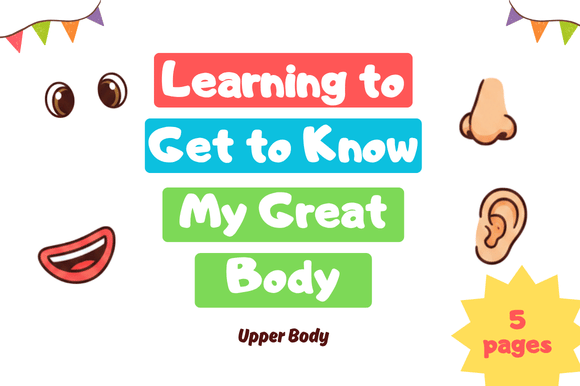
Learning the Top of My Body worksheets honor that natural progression. They don’t overwhelm with 20+ terms. Instead, they spotlight eight core features—eyes, ears, nose, mouth, hair, forehead, cheeks, and chin—with clear, friendly illustrations and consistent labeling. Each element is introduced through repetition, visual association, and simple action prompts (“Point to your nose,” “Touch your ears,” “Show me your smile”).
What’s Inside the Digital Resource Set?
This digital product includes a thoughtfully designed 5-page set—delivered as a single ZIP file—optimized for real-world classroom and home use:
- 5 high-resolution JPG files, each at 300 DPI for crisp, professional printing;
- All formatted to standard A4 paper size—no resizing or cropping needed;
- No software dependencies: open, print, and teach immediately;
- Clean, uncluttered layouts with ample white space—ideal for young learners’ focus and fine motor development;
- Neutral, inclusive clip art: diverse skin tones, varied hair textures, and gender-neutral styling ensure every child sees themselves reflected.
Unlike generic coloring pages or flashcards, these sheets are built for purposeful engagement. One page may invite tracing facial outlines; another asks students to match words to pictures; a third uses dotted lines to support early writing of key vocabulary like “eyes” or “nose.” There’s even a simple “My Face” self-portrait template—designed not for artistic perfection, but for observation, memory, and ownership.
How Teachers and Homeschoolers Are Using These Worksheets
In preschool classrooms, educators often weave Learning the Top of My Body into morning meetings or sensory stations. A teacher might begin circle time by singing “Head, Shoulders, Knees and Toes”—then pause after “head” to pull out the worksheet and ask, “What’s *on* your head? Let’s find it together.” That moment bridges music, movement, and visual recognition.
Homeschool parents appreciate how seamlessly these pages integrate into themed units—like “All About Me” or “Our Senses.” One parent shared using the ear illustration while exploring sound: “We taped cotton balls behind our ears and listened to rainsticks—then colored the ‘ears’ page together. It made the abstract idea of hearing feel concrete.”
Special educators have adapted the materials for students with speech delays or sensory processing differences. The clean visuals reduce cognitive load, while the consistent layout supports predictability—a key factor in building confidence. Some add velcro pieces for tactile matching, or laminate pages for dry-erase tracing practice.
More Than Just Labeling: Building Foundational Skills
At first glance, naming body parts may seem basic—but Learning the Top of My Body quietly reinforces multiple early learning domains:
- Language development: Vocabulary expansion, following multi-step directions (“Circle the eyes and underline the nose”), and articulating simple sentences (“This is my mouth”);
- Fine motor practice: Tracing, coloring within boundaries, cutting along guided lines, and pasting cut-outs onto corresponding spots;
- Social-emotional growth: Recognizing facial expressions helps children identify feelings in themselves and others—supporting empathy and self-regulation;
- Pre-literacy skills: Letter formation (writing “E” for eyes), left-to-right tracking, and visual discrimination between similar shapes (e.g., round eyes vs. oval ears).
Even handwriting readiness gets a boost. The worksheets include gentle stroke guides—not full letter drills, but directional cues that mirror pencil control needed for future writing. A child tracing the curve of a smiling mouth is also practicing the same motion used to form lowercase “c” or “o.”
Practical Tips for Getting the Most From the Resource
You don’t need a full unit plan to make these worksheets effective. Here’s what works well in real settings:
- Start small. Introduce just two features per session—say, eyes and ears—then reinforce them across activities (listening games, mirror play, storytime). Overloading leads to surface-level recall, not true understanding.
- Connect to routine. Link vocabulary to daily life: “We use our nose to smell breakfast,” “We use our mouth to say ‘thank you.’” Repetition in context sticks far better than isolated drills.
- Invite movement. Pair each worksheet with a quick physical cue: wiggle your ears, blink rapidly, puff your cheeks. Kinesthetic reinforcement boosts retention and keeps energy positive.
- Extend beyond the page. After completing a sheet, take a photo of the child pointing to their own features—or make a simple “Top of My Body” poster using magazine cutouts and glue. Real-world application cements learning.
Why Digital—and Why This Format—Matters
In today’s busy educational landscape, time is scarce. Teachers juggle planning, grading, IEP documentation, and family communication. A ready-to-print digital resource eliminates hours spent sourcing images, adjusting sizes, or troubleshooting formatting issues. No subscriptions. No logins. Just download, unzip, and go.
The choice of JPG over PDF or editable formats is intentional. PDFs sometimes require special software to print correctly; editable files demand design know-how many educators don’t have or want to learn. JPGs open universally—in browsers, email attachments, Google Drive, even phones—and print flawlessly on any home or school printer. And because they’re 300 DPI, they scale beautifully—even if you choose to project one onto a smartboard for group instruction.
Plus, being digital means flexibility. Print one copy for a student who needs extra support. Print ten for a whole-group activity. Print in grayscale to save ink—or in color for visual impact. You decide what fits your day, your students, and your goals.
Who Benefits Most From This Resource?
While designed for preschool and kindergarten, Learning the Top of My Body has proven useful across broader contexts:
- Early intervention specialists working with toddlers developing body schema;
- ESL/ELL teachers supporting newcomers with visual vocabulary scaffolds;
- Occupational therapists incorporating body awareness into sensory diets;
- After-school program staff looking for low-prep, high-engagement activities;
- Parents of neurodiverse children seeking predictable, non-threatening ways to discuss identity and autonomy.
One kindergarten teacher noted, “I used this with a student who rarely spoke in full sentences. After three weeks of pairing the ‘mouth’ worksheet with blowing bubbles and saying ‘pop,’ he started whispering the word—and then saying it clearly. It wasn’t about the worksheet alone. It was the consistency, the clarity, the repetition. It gave him a foothold.”
Final Thought: Simplicity With Purpose
There’s power in simplicity—especially when it’s rooted in how children actually learn. Learning the Top of My Body doesn’t try to be everything. It focuses deeply on what matters most at this stage: seeing, naming, feeling, and claiming one’s own body. It meets kids where they are—not with complexity, but with clarity, care, and quiet confidence.
Whether you’re guiding 20 preschoolers in a sunlit classroom or sitting cross-legged on a rug with your kindergartener at home, these five pages offer more than practice. They offer presence. Connection. A starting point—one thoughtful, printable step at a time.