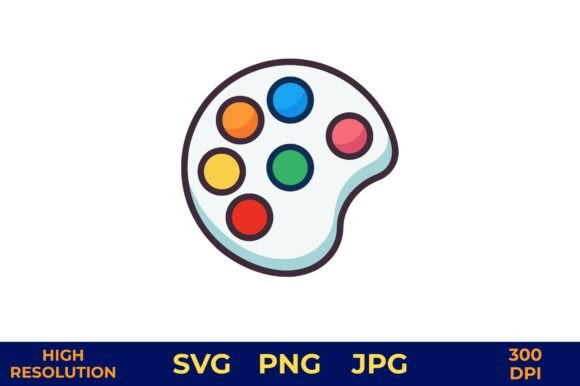
Paint Palette with Circular Blobs
If you’ve ever scrolled through design marketplaces searching for a fresh, joyful visual to elevate your project—whether it’s a wedding invitation suite, a social media post for your small business, or printable planner stickers—you’ve likely paused on a Paint Palette with Circular Blobs. This isn’t just another clipart-style palette. It’s a vibrant, intentionally designed vector illustration: clean lines, bold circular paint blobs in saturated hues, and crisp isolation on white—ready to scale, recolor, layer, or print without losing clarity.
What makes it especially useful is how it bridges simplicity and versatility. Unlike hand-drawn palettes that feel too literal—or abstract graphics that lack warmth—the Paint Palette with Circular Blobs lands right in the middle: playful enough for a bridal shower banner, polished enough for a florist’s branding kit, and precise enough for high-res product mockups like mugs or tote bags.
Common Missteps—and Why They Cost Time (and Confidence)
Many people download a paint palette graphic thinking, “It looks great in the preview—done!” Then they open it and hit one of these practical roadblocks:
- Assuming all file formats behave the same. A JPG may look sharp on screen but lacks transparency—so when you try to overlay it on a pastel background or custom pattern, you get an awkward white box around the palette. That’s why this version includes SVG, PNG, *and* JPG—with transparent backgrounds in both SVG and PNG. Use SVG for web scalability (logos, websites), PNG for quick drag-and-drop into Canva or Photoshop, and JPG only if you’re embedding in email templates where transparency isn’t needed.
- Overlooking resolution needs before printing. You might design a 5x7" wedding menu in Canva, drop in the palette, and hit “print”—only to find soft edges or pixelation. That’s because many free downloads max out at 72 dpi or 1000px width. This Paint Palette with Circular Blobs delivers 4200px × 4200px at 300 dpi—enough to print sharply at 14" × 14" or scale down cleanly for tiny sticker sheets. Always check your final output size *before* placing the asset—not after.
- Misjudging color flexibility. Some palettes use flat, uneditable colors baked into raster layers. Others lock hues inside grouped vector objects, making recoloring tedious. Here, each circular blob is a separate, ungrouped vector shape—so changing one blob from cobalt blue to terracotta takes two clicks in Illustrator or Affinity Designer. No hunting through layers or breaking apart compound paths.
What to Verify Before Downloading (or Buying)
Before adding any digital asset to your workflow—even something as straightforward as a Paint Palette with Circular Blobs—ask yourself three quiet but critical questions:
- Will I need to resize it dramatically? If you plan to use it on a large-format poster *and* as a watermark on Instagram Stories, SVG is your safest bet. Raster files (PNG/JPG) are fine for consistent sizes—but avoid stretching them beyond 120% of original dimensions unless you’re certain of the source resolution.
- Do I need to match brand colors precisely? Check whether the file opens with editable swatches or hardcoded hex values. This version uses standard CMYK/RGB-friendly fills, so swapping in your brand’s exact #8A2BE2 or Pantone 2685 C is seamless—not guesswork.
- Where will it live long-term? If it’s for client work (e.g., a photographer’s welcome packet or a planner’s digital workbook), confirm licensing allows commercial use *without attribution*. This Paint Palette with Circular Blobs grants full commercial rights—no hidden limits on quantity, platforms, or resale in derivative products like printable kits.
Real-World Uses—Beyond the Obvious
Yes, it works beautifully on greeting cards and social posts. But its real strength shows up in less obvious places:
- Florists building mood boards: Drop the palette behind a photo of ranunculus and eucalyptus—its circular blobs echo organic petal shapes while grounding the composition with intentional color rhythm.
- Educators designing classroom resources: Use individual blobs as clickable elements in interactive PDFs (e.g., “Tap the red blob to hear the word ‘apple’”)—thanks to clean vector boundaries and no stray anchor points.
- Small-biz owners prototyping packaging: Layer the palette over mockup templates for soap labels or candle jars. Because it’s 300 dpi and transparent, shadows and textures underneath remain visible—no flattening required.
Avoiding the “Just Add Water” Trap
Some creators assume that because a design looks cheerful and handmade, it’ll automatically “fit” any aesthetic. But context matters. A vibrant Paint Palette with Circular Blobs can feel jarring beside minimalist serif typography or muted linen textures—if not balanced thoughtfully.
Instead of dropping it in untouched, try one of these subtle refinements:
- Tint the background layer (not the palette itself) with a 5% warm gray to soften contrast without dulling the blobs.
- Reduce blob opacity by 8–12% for a watercolor-like lift—especially effective on invitations or botanical-themed stationery.
- Use only 3–4 blobs instead of all eight, then align them along a diagonal grid. This creates movement without visual noise.
These aren’t rules—they’re gentle nudges toward intentionality. The palette doesn’t need to carry the whole design; often, it works best as a quiet accent that signals creativity without shouting.
Final Thought: Clarity Over Cuteness
There’s no shortage of “artsy” graphics online. What sets this Paint Palette with Circular Blobs apart isn’t just its brightness—it’s the care behind its construction. Every curve is smooth at any scale. Every color sits confidently in sRGB and CMYK spaces. Every file type serves a clear purpose. That means less troubleshooting, fewer last-minute swaps, and more time spent on what actually moves your project forward: storytelling, connection, and craft.
You’re not just downloading a picture. You’re adding a reliable, adaptable tool—one that respects your time, your standards, and the people who’ll see your work.